
How I Generate Alpha in Quant Trading in 2026: A 4-Step Scientific Process
How to Build Top 1% Trading Strategies in 2026

Dear Quantitative Traders,
Today, I’ll explain how I build top-1% trading strategies.
I don’t start by coding. I start by filtering.
Lately I’ve seen that some traders open their “backtester“ immediately. They let AI find an idea, they backtest it, backtest works well and they trade it. I don’t do that.
My workflow starts before I write a single line of code.
Finding an idea comes first, usually from academic papers, trusted sources, or my own testing. My favorite academic sources are platforms like SSRN, Science Direct, arXiv and Research Gate.
But before I build the strategy, I test the signal itself using a relatively old method called Information Correlation (IC).
The goal is not to see if the signal works, it’s to see if the edge is stable.
The concept of IC was popularized by Richard Grinold and Ronald Kahn in their book Active Portfolio Management.
This is the framework used by the quants at firms like BlackRock and Goldman Sachs etc to separate “alpha” from “random noise.”
I need to see the rolling window of IC across the years. Sometimes I use T-stats (Statistical Significance) to ensure the signal is mathematically different from zero, but I prefer to visually analyze the rolling (history) IC and Information Ratio (IR).. Edge must be stable.

Creating the Strategy (The “Fees First” Approach)
Opening RealTest is the next step.
Slippages, limit extra buffers, and commissions get added immediately. Adding them a little bit higher than usual ensures that even in worst-case scenarios, the systems will perform well.
That mistake has cost me before. Starting a strategy and later adding commissions is a complete waste of time. Small trades get eaten alive by fees.
Cliff Asness of AQR often warns about “backtest overfitting” where fees and turnover destroy an idea. By putting fees first in RealTest, I am avoiding what the institutions call “Implementation Shortfall” the gap between a theoretical 1% trader and a real-world profitable one.
But why do I use RealTest? Because it’s so easy to create strategies fast. And I run them live via OrderClerk, so my system must be in RealTest.

Validation: The “Time Machine”
Once the strategy is coded in RealTest, I put it through my version of a “Time Machine.”
The first run covers the earliest available historical data up to 2010. I use 2010 as my “line in the sand” because the post-2008 financial crisis era represents a massive shift in market regime, it’s the birth of the modern, high-liquidity, and high-frequency environment we trade in today.
Next is Walk-Forward Optimization (WFO). This reveals how the strategy behaves “Out of Sample” from 2010 to today. By withholding this data during the initial design, I can see if the logic actually has predictive power or if I just got lucky with the past.
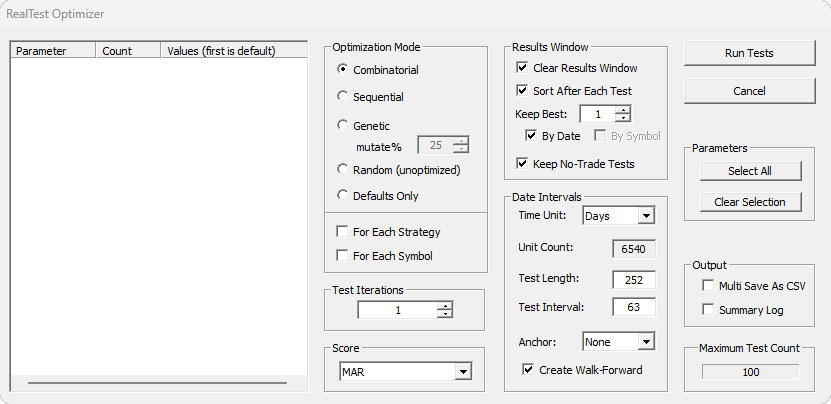
If the strategy performs with the same stability from 2010 to the present day, I know the edge is robust. During this phase, I’m not just looking at the total return. I am checking for specific health metrics:
MAR Ratio: To ensure the returns are worth the drawdowns.
Expectancy: To confirm that every trade, on average, is putting a specific dollar amount in my pocket after friction.
Monte Carlo Analysis: I run hundreds of simulations in RealTest.

Brand New System

Why I Don’t Use AI Agents
AI agents don’t touch my testing process because I’ve found they make a lot of mistakes, and simply put: my money is in the game.
I know there are quants out there running AI 24/7, testing hundreds of signals a day to find that “perfect” correlation. But in my experience, that leads to a high chance of overfitting. If you test enough random signals, you will eventually find one that looks amazing historically just by luck but it has no real predictive power.
I subscribe to Ray Dalio’s philosophy at Bridgewater: you must have a “timeless and universal” understanding of why a trade works. Dalio has famously warned against “blind faith” in machine learning/AI, arguing that if you can’t explain the cause-and-effect relationship behind a signal, you are just trading a mathematical accident that won't exist tomorrow.
I need to know 100% what the underlying driver of a signal is. I refuse to trade “black box” signals where I can’t understand why it worked in the past. My psychology requires that deep understanding, I can’t stick to a strategy during hard times (bearish markets) if I don’t know why it exists.
I’ve also experienced huge time losses trying to force AI into this workflow. I once let an agent perform a bunch of tasks, only to realize hours later that it had built everything on a false premise. It was a complete waste of time.
That is why I write code manually. I need to understand every single line of code to ensure there are no hidden errors. Unstructured AI generation (vibe coding) with AI is cool, and I do it for fun projects but I never let it handle the trading side. I save the vibe coding for when my trading capital is not in danger.

From Demo to Live
Demo trading in IBKR used to be my routine for a few months. But now I feel very confident when I make my strategies (because of the process), so I directly test with real money (but with risk much less).
Strategy frequency dictates the test duration whether it is high-frequency or slower.
Then comes the comparison: backtest vs. live results. Slippage, fills, commissions.
I’ve never had problems with that because in the backtest I add slightly higher fees.
Once I’m confident, I slowly add more money into this strategy in my live system.

The Secret
People will ask: “What’s the most important part?” I would say all of them.
I know this is a very time-consuming process. Truly developing a institutional-grade strategy can take up to a year when you include the research, coding, and the necessary live "out-of-sample" testing. I realize that most people simply don’t have the technical knowledge or the hundreds of hours required to do this properly. But if you want to be in the top 1%, you cannot skip the work.
Or simply download premium our strategies if you don’t have time or knowledge to do the hard work.